
Top 10 18650 Battery Manufacturers for Global Buyers
Choosing the right 18650 Battery manufacturer can shape product safety, operating life, and procurement stability. Global buyers need more than attractive prices. They need verified specifications, consistent production, and responsive technical support.
This guide examines ten manufacturers serving international markets. It considers cell capacity, voltage stability, cycle performance, thermal behavior, quality systems, and production traceability. It also reviews certifications, sample testing, minimum order quantities, packaging standards, and after-sales communication. These details matter when cells power laptops, flashlights, medical devices, energy storage systems, or electric tools.
Real sourcing experience shows that datasheets do not tell the whole story. A batch may meet its rated capacity yet perform differently under high-current loads. Small differences can become significant inside a battery pack. Buyers should request recent test reports, inspect labeling, and compare independent samples before placing large orders. Safety comes first.
The ranking is not absolute. Supplier suitability depends on application requirements, budget, region, and compliance expectations. Some manufacturers excel in high-volume production. Others provide stronger customization or better support for smaller buyers. That distinction is easy to overlook.
A reliable evaluation also requires checking documentation carefully. Look for clear model numbers, manufacturing dates, protection guidance, and transport information. Avoid offers with unclear origins or unusually low prices. They may indicate inconsistent quality, although price alone cannot prove a supplier’s reliability.
This overview offers a practical starting point, not a substitute for technical validation. Battery performance varies by design and use. Buyers should verify every critical claim before committing.
18650 Battery Basics and Key Specifications
18650 Battery Basics and Key Specifications
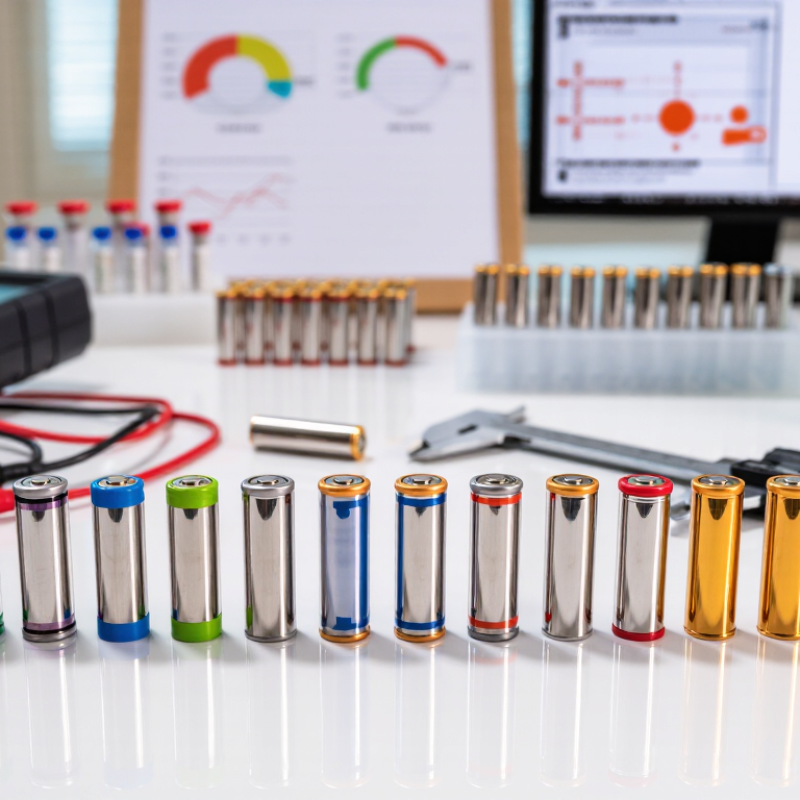
An 18650 battery typically measures about 18 millimeters wide and 65 millimeters long. Its nominal voltage is usually 3.6 or 3.7 volts, while full charging reaches 4.2 volts. Capacity is listed in milliamp-hours, such as 2,500 mAh or 3,500 mAh. Higher capacity can extend runtime, but it may reduce maximum discharge performance.
Discharge rating matters in tools, mobility equipment, and backup systems. A battery marked for 20 amps should be evaluated using its continuous rating, not a brief pulse figure. Energy can be estimated with this formula: watt-hours equal amp-hours multiplied by voltage. Chemistry also affects performance, cycle life, and thermal behavior. Check the datasheet carefully.
Small details matter. Inspect the wrapper, terminals, batch code, and insulation ring before assembly. Matched cells should have similar capacity and internal resistance. A protection circuit or battery management system can help control overcharge, over-discharge, and overheating. Use a compatible charger and follow applicable transport and recycling rules.
I have learned that a clean label proves very little. Independent capacity testing is more reliable. Some results vary with temperature, test current, and equipment quality. Even experienced buyers can overlook storage conditions. That weakness deserves attention. A careful specification review should include operating temperature, cycle-life test conditions, warranty terms, and traceable quality records.
| No. | 18650 Battery Category | Typical Chemistry | Nominal Voltage | Typical Capacity Range | Typical Continuous Discharge Range | Standard Dimensions | Charge Method | Typical Cycle-Life Range | Main Advantages | Important Selection Considerations |
|---|---|---|---|---|---|---|---|---|---|---|
| 1 | High-Capacity Energy Cell | Nickel Manganese Cobalt Oxide (NMC/NCA) | 3.6–3.7 V | 2,500–3,500 mAh | 5–10 A | Approximately 18 mm diameter × 65 mm length | Constant-current/constant-voltage charging to 4.2 V | Approximately 300–800 cycles | High energy density and long runtime for compact equipment. | Confirm the cell’s tested capacity, thermal limits, and approved charging current. Not intended for high-current power tools unless specifically rated. |
| 2 | High-Drain Power Cell | NMC/NCA | 3.6–3.7 V | 2,000–3,000 mAh | 15–30 A | Approximately 18 mm diameter × 65 mm length | Constant-current/constant-voltage charging to 4.2 V | Approximately 300–700 cycles | Supports higher power output for demanding portable devices. | Actual continuous-current performance depends on temperature, cell temperature rise, cutoff voltage, and pack design. |
| 3 | Long-Life LCO Cell | Lithium Cobalt Oxide (LCO) | 3.6–3.7 V | 2,000–3,000 mAh | 2–8 A | Approximately 18 mm diameter × 65 mm length | Constant-current/constant-voltage charging to 4.2 V | Approximately 300–500 cycles | Good energy density and a mature format for low-to-moderate power applications. | Requires appropriate protection against overcharge, over-discharge, short circuit, and excessive temperature. |
| 4 | High-Safety LFP Cell | Lithium Iron Phosphate (LFP) | 3.2–3.3 V | 1,100–2,000 mAh | 10–30 A | Approximately 18 mm diameter × 65 mm length | Constant-current/constant-voltage charging to approximately 3.65 V | Approximately 1,500–3,000 cycles | Strong thermal stability, long service life, and good power capability. | Lower voltage and energy density than most cobalt- or nickel-based cells; the charger must be designed for LFP chemistry. |
| 5 | Protected 18650 Cell | Usually NMC, NCA, LCO, or LFP with a protection circuit | 3.2–3.7 V | 1,500–3,500 mAh | Typically 2–15 A | Approximately 18 mm diameter × 65–70 mm length | Must match the underlying chemistry and protection circuit | Depends on the underlying cell chemistry and operating conditions | Provides basic electronic protection against overcharge, over-discharge, and short circuit. | Protection circuits increase length and diameter. Verify device compatibility, cutoff settings, current rating, and whether a protected cell is required. |
| 6 | Unprotected Industrial Cell | NMC, NCA, LCO, or LFP | 3.2–3.7 V | 1,100–3,500 mAh | Application-specific; commonly 5–30 A | Approximately 18 mm diameter × 65 mm length | Requires a compatible battery-management system and charger | Approximately 300–3,000 cycles, depending on chemistry | Compact dimensions and flexible integration into professionally designed battery packs. | Should not be used as a loose consumer battery. The finished pack needs cell balancing, thermal monitoring, over-current protection, and safe mechanical construction. |
| 7 | Button-Top 18650 Cell | Usually lithium-ion NMC, NCA, or LCO | 3.6–3.7 V | 1,500–3,500 mAh | Typically 5–20 A | Approximately 18 mm diameter × 67–69 mm length | Constant-current/constant-voltage charging to 4.2 V | Approximately 300–800 cycles | May fit devices designed for raised positive terminals and spring contacts. | Button-top construction can be too long for some battery holders. Check the complete mechanical dimensions before ordering. |
| 8 | Flat-Top 18650 Cell | Usually lithium-ion NMC, NCA, LCO, or LFP | 3.2–3.7 V | 1,100–3,500 mAh | Typically 5–30 A | Approximately 18 mm diameter × 65 mm length | Must match the cell chemistry and pack-management system | Approximately 300–3,000 cycles, depending on chemistry | Commonly used in welded battery packs and compact holders. | Flat-top and button-top cells are not always interchangeable. Verify terminal geometry, contact pressure, insulation rings, and pack assembly method. |
| 9 | Low-Temperature Application Cell | Specialized lithium-ion formulation, commonly NMC-based | 3.6–3.7 V | 1,800–3,000 mAh | Typically 3–15 A at low temperature | Approximately 18 mm diameter × 65 mm length | Charging below 0°C generally requires a manufacturer-approved low-temperature solution | Varies substantially with temperature profile and charging conditions | Designed to retain more usable performance in cold environments than standard cells. | Low-temperature discharge capability does not automatically mean safe low-temperature charging. Use temperature sensors and charging limits. |
| 10 | Recycled-Content or Refurbished Cell | Varies; commonly recovered lithium-ion chemistries | 3.2–3.7 V | Often 1,000–3,000 mAh after testing | Must be established through individual testing | Approximately 18 mm diameter × 65 mm length, subject to wear and prior use | Must match the verified chemistry and measured condition | Remaining life is highly variable | Can reduce material waste when cells are professionally tested and graded. | Require traceability, capacity testing, internal-resistance testing, visual inspection, insulation checks, and clear grading. Avoid unverified cells for safety-critical packs. |